
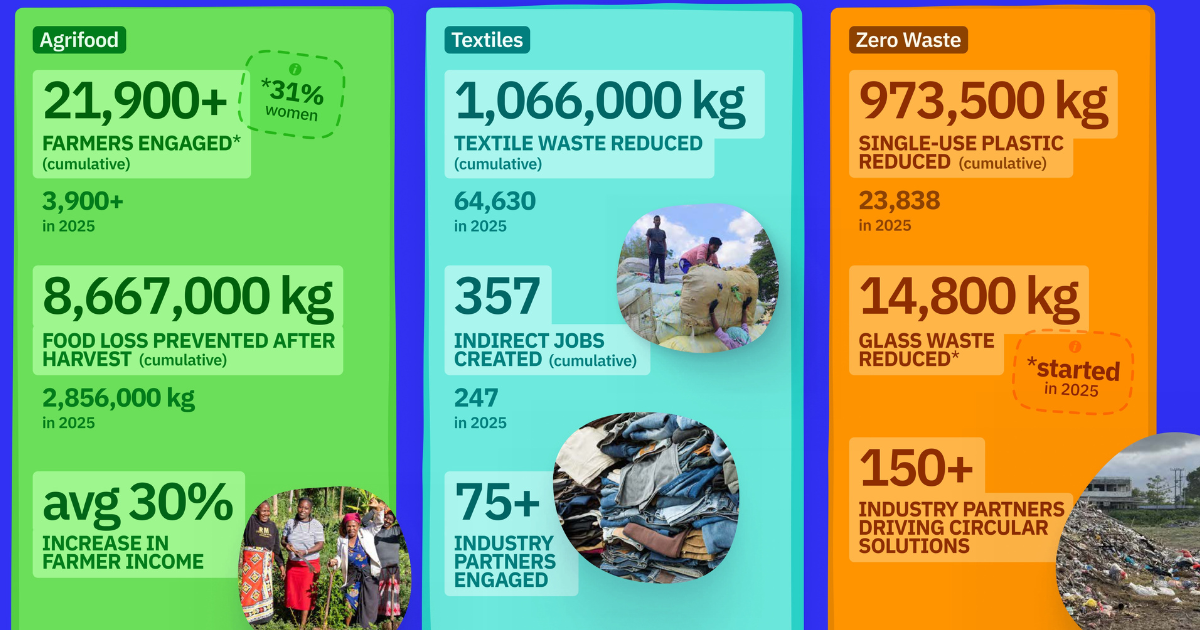
Enviu today launched its 2025 Impact Report, revealing how its portfolio of impact ventures is delivering measurable returns for people, markets, and systems. Across the agrifood portfolio, every euro of catalytic funding now mobilises €7.9 in total capital, up from €5.6 in 2024, while post-harvest food loss ventures have cumulatively generated €7 million in monetised impact across farmer income, food security, job creation, and environmental value. Cumulatively, Enviu's ventures have avoided 202,000 tonnes of CO₂-equivalent emissions and reduced nearly 10.7 million kg of waste, with both figures growing by more than 60% year-on-year. Women's participation in farming nearly doubled, and more than 1,600 micro-entrepreneurs gained sustainable economic opportunities.
In Kenya, SokoFresh has helped 19,634 farmers and value chain actors reduce post-harvest food loss while increasing farmer incomes by 15–30%; Shambani Pro is connecting smallholders directly to buyers, with women now representing 55% of all engaged farmers, an 88% increase year-on-year.
Shambani Pro pays us fairly based on actual weight, and their prices are better. As a full-time farmer, I rely entirely on farming income, so consistency and fairness are very important to me.Peter Mutinda Muteti, 56, smallholder farmer, Kenya
In India, Second Spin is diverting institutional textile waste from 77 hotel partners across 10 cities, while workers at partner facility Saahas Zero Waste earn formal salaries benchmarked against city minimum wages, and the model has now expanded to Gurgaon.
In Indonesia, Alner grew its customer base by 30% in 2025, reducing 15.5 tonnes of single-use packaging through a network of 1,470 warungs and micro-retailers.
Also in Indonesia, Enviu co-founded AGUNI in 2025, the country's first association dedicated to making reuse the primary solution to plastic pollution. Bringing together government, industry, and civil society across the value chain, AGUNI is developing shared standards and enabling reuse to scale nationally, with more than 1,000 refill and reuse points already active across the country.
Narrowing down to Bali, Destination Zero Waste achieved a 76.6% reduction in single-use plastics across five hotels in just three months, proving that collective action across the hospitality sector can move faster than individual commitment, and already spawning a new venture, KemBali, to take the model further.
Our hotel launched its Destination Zero Waste Bali campaign in June, and while results show progress, the real success lies in the active participation of our guests and team members.Dino Anthonio, General Manager, TUI BLUE Berawa
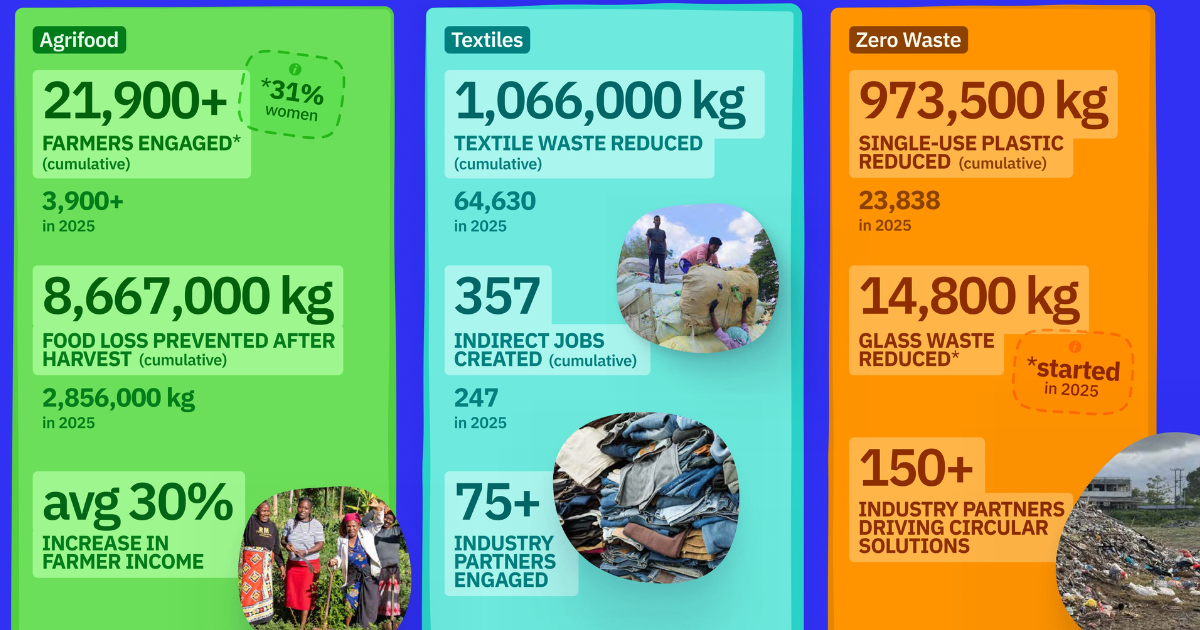
Meanwhile, the Herbruikbare Wijnfles initiative introduced the Netherlands' first universal reusable wine bottle system, now active across 81 hospitality and event venues, diverting 39,000 single-use bottles and achieving up to 83% CO₂ reduction per bottle, with the work since expanded into the EU-funded Interpool cross-border pooling project.
Together, these ventures are proving that impact and commercial viability can coexist to build the infrastructure for markets that did not exist before.
The Fastest-Growing Demographic in Kenyan Agriculture Is Women — Women now represent 55% of all farmers engaged across Enviu's agrifood ventures, up 88% year-on-year. For journalists covering food security, climate adaptation, or gender and economic inclusion, this is a trend story with the numbers to support it.
93%: The Number That Answers Impact Investing's Hardest Question — The most common objection to circular economy models is that people won't change behaviour. The Allas pilot, a 93% cup return rate and 4,500 single-use items avoided in one month across just two institutions, is a direct, data-backed rebuttal. Tight, scalable, and replicable.
Can Tourism Fix Its Plastic Problem? Bali Has an Answer — Travel and hospitality press rarely intersects with systems change reporting. Destination Zero Waste Bali, a 76.6% plastic reduction across five hotels in three months, opens that door with a ready-made follow-up venture in KemBali and a replicable model for other destinations.
Dirty Work, Dignified Life: Why Zarina Is Proud of What Others Look Away From — Textile sorting carries social stigma in India. Zarina, 19, faced it directly when she joined a Bangalore sorting facility after moving from Uttar Pradesh. Two years later, she earns ₹15,000 a month in a formal role with trained skills, paid leave, and a clear career path. Her story is not just about one job. It is about what happens when an entire supply chain is redesigned around dignity, and why that matters for India's 40 million young people entering the workforce each year.
The 8x Effect: One Ship Recycler's Case for Catalytic Capital — Marine Metals mobilised €8 for every €1 of early-stage funding, backed by a named, verifiable case. For journalists covering green infrastructure, circular manufacturing, or impact investing, this is a concrete proof point with a compelling visual hook: old ships becoming high-grade steel.
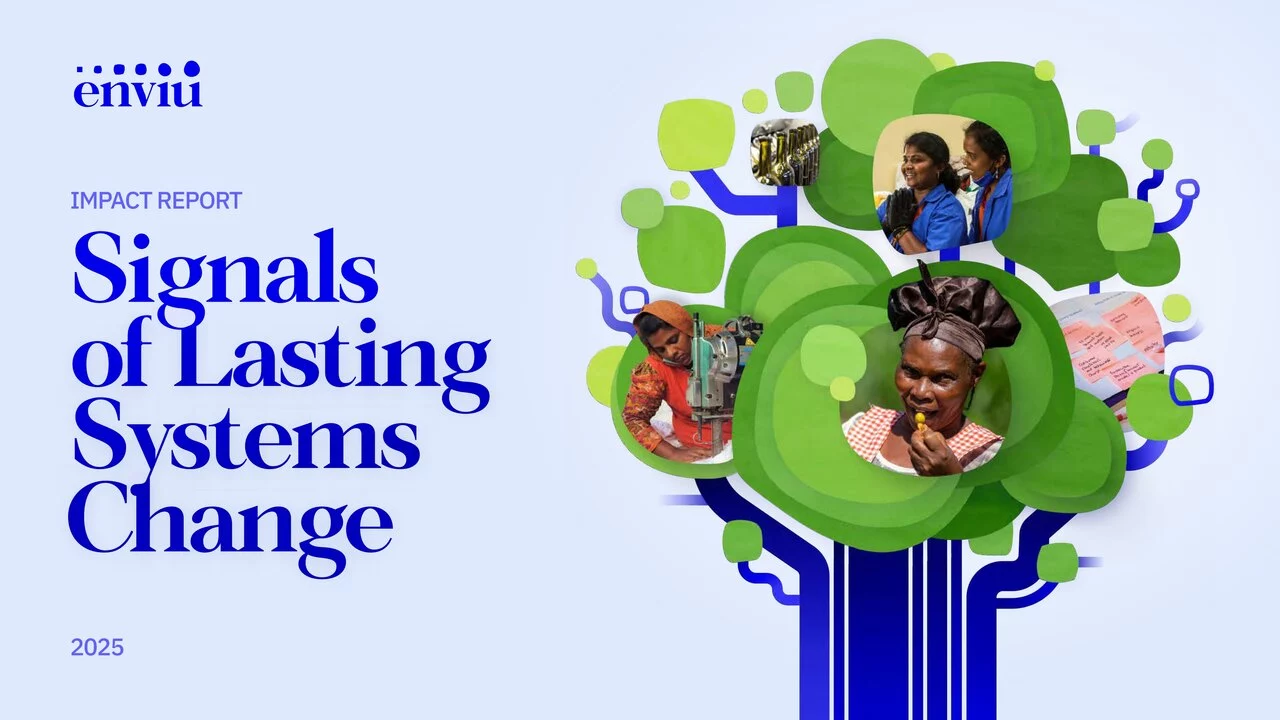
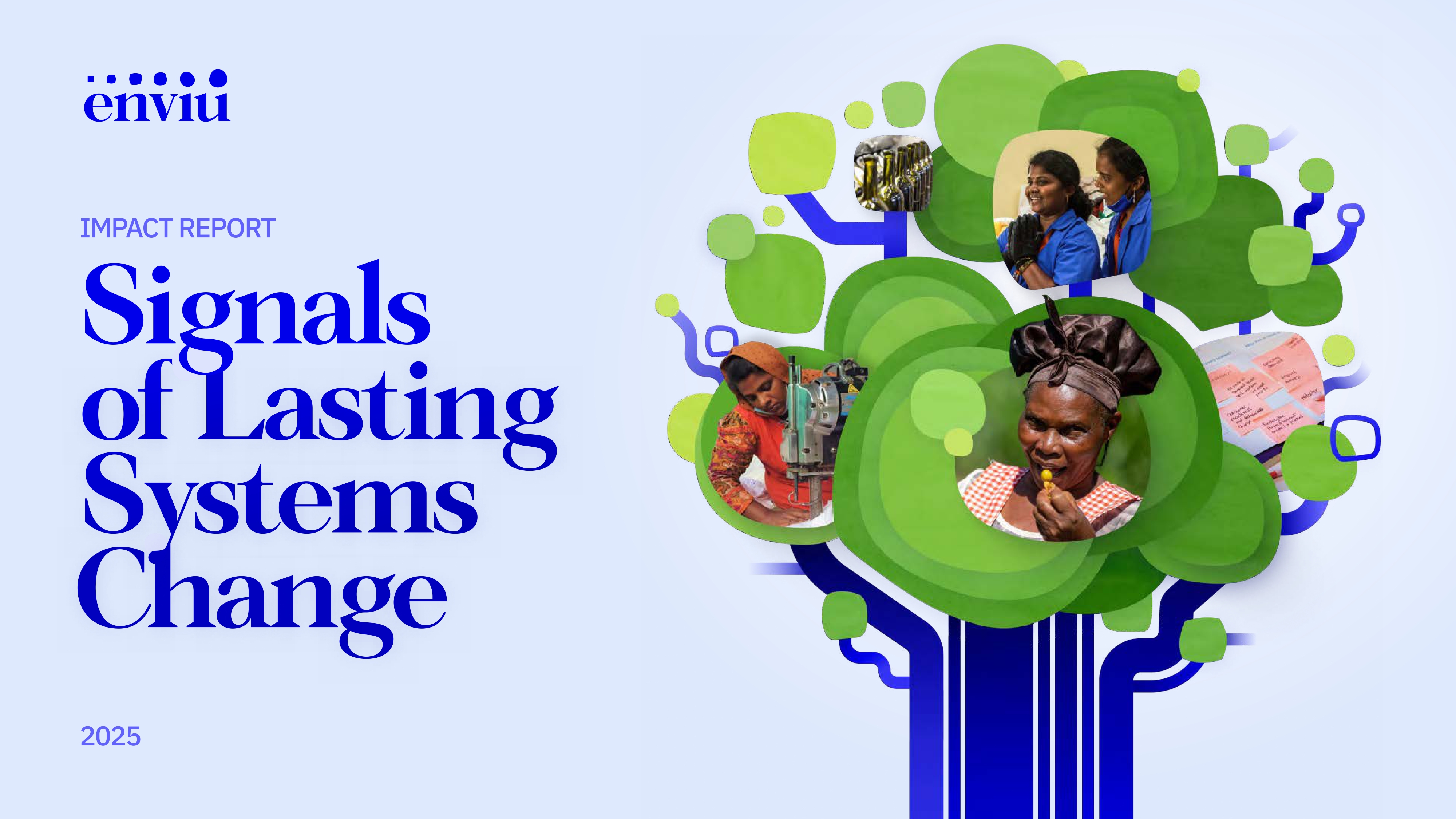
The full 2025 Impact Report is available here. We are offering exclusive interviews with our Co-CEOs, access to on-the-ground venture teams, and an introduction to the farmers, workers, and entrepreneurs at the centre of this work. If systems change is a beat you care about, reach out.